
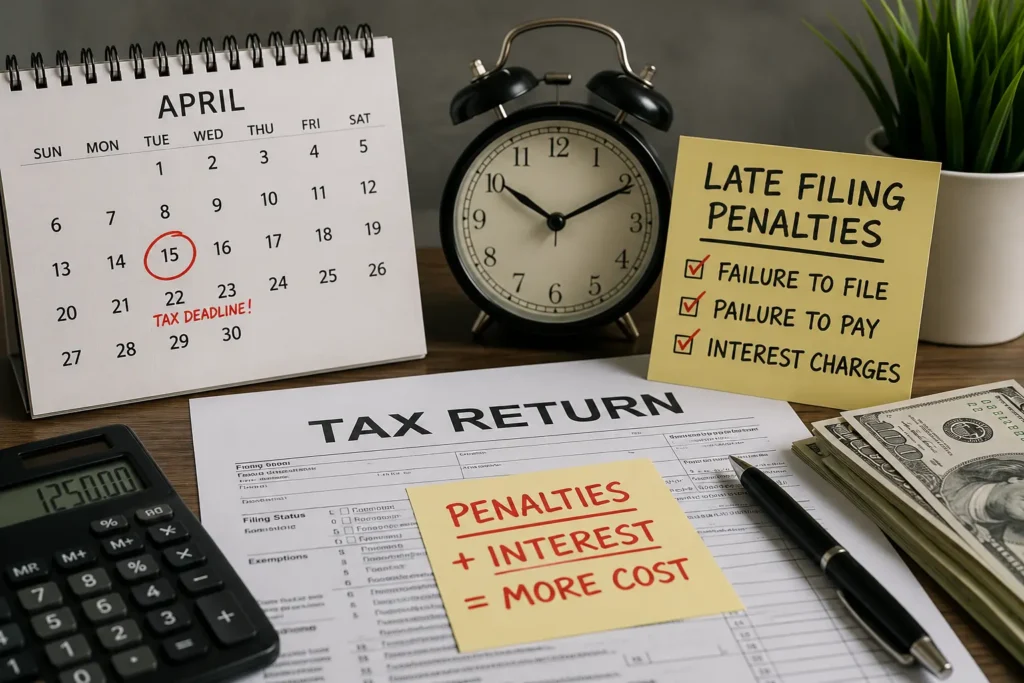
Life gets busy, and tax deadlines slip. If you’ve missed the filing deadline, you’re probably wondering what happens next — and how bad it’s going to be. The short answer: it depends on whether you owe money, how late you are, and how quickly you act. Our team walks clients through this exact situation every year, so we’ve put together a clear breakdown of what actually happens when you file late and what we recommend you do next.
The Two Penalties You Need to Know About
When you file late, the IRS can apply two separate penalties, and they stack on top of each other if you’re not careful.
Failure-to-File Penalty
The IRS charges 5% of your unpaid taxes for each month (or part of a month) your return is late, up to a maximum of 25%. This penalty is significantly steeper than the failure-to-pay penalty below, which is exactly why our team always tells clients to file on time even if they can’t pay in full yet.
Failure-to-Pay Penalty
Separately, the IRS charges 0.5% of your unpaid taxes per month if you don’t pay what you owe by the deadline, also capped at 25%. If both penalties apply in the same month, the IRS reduces the failure-to-file penalty by the failure-to-pay amount, so you’re not charged the full 5.5% combined — but you’re still accumulating charges every month you wait.
Interest on Unpaid Taxes
On top of both penalties, the IRS charges interest on any unpaid balance, calculated daily from the original due date until you pay in full. Interest rates adjust quarterly, so the longer your balance sits, the more it compounds.
What If You’re Owed a Refund?
Here’s some good news: if the IRS owes you money, there’s no penalty for filing late. The IRS doesn’t penalize late filers who are due a refund, but you generally have only three years from the original due date to claim it before it’s gone for good. Our team still recommends filing as soon as possible, since waiting only delays money that’s already yours.
What Happens If You Ignore It Completely
Filing late is one thing. Not filing at all is a different problem entirely. If you continue to ignore your filing obligation, the IRS can:
- File a “substitute return” on your behalf, typically without deductions or credits that would lower your bill
- Assess penalties and interest based on that inflated substitute return
- Begin collection actions, including liens or levies, once the balance goes unaddressed long enough
We review situations like this often, and the outcome is almost always more expensive than simply filing — even a late one — would have been.
What We Recommend You Do Right Now
If you’ve missed the deadline, our team recommends the following steps, in this order:
- File as soon as possible. Every month you wait adds another failure-to-file penalty charge, so speed matters more than perfection.
- Pay what you can, even if it’s not the full amount. Partial payments reduce the balance that interest and the failure-to-pay penalty apply to.
- Ask about penalty relief. If this is your first late filing or you have reasonable cause, the IRS may abate certain penalties, and our team can help evaluate whether you qualify.
- Set up a payment plan if needed. We help clients establish IRS installment agreements when paying the full balance immediately isn’t realistic.
- Get ahead of it next year. We can build tax planning into our ongoing client relationships specifically, so this doesn’t happen again.
How Our Team Helps Clients Who’ve Filed Late
We provide tax preparation services for clients at every stage of a late-filing situation — whether you’re one month behind or several years behind. Our team reviews your prior returns, identifies what’s owed, and works directly with the IRS on your behalf so you’re not navigating notices and deadlines alone.
If your books are part of what’s holding up your filing, our bookkeeping services and monthly bookkeeping and tax services get your records current so we can file an accurate return quickly, instead of reconstructing a year of transactions from scratch. For business owners specifically, we also offer business advisory support to help you build habits and systems that keep you ahead of deadlines going forward.
Talk to Our Team Before the Problem Grows
The longer a late return sits, the more expensive it becomes. Our team has helped Denver-area individuals and business owners resolve late filings, negotiate penalty relief, and get back on solid footing with the IRS. If you’ve fallen behind — whether by a few weeks or several years — schedule a consultation with our team today, and we’ll walk you through exactly where you stand and what we recommend next.


